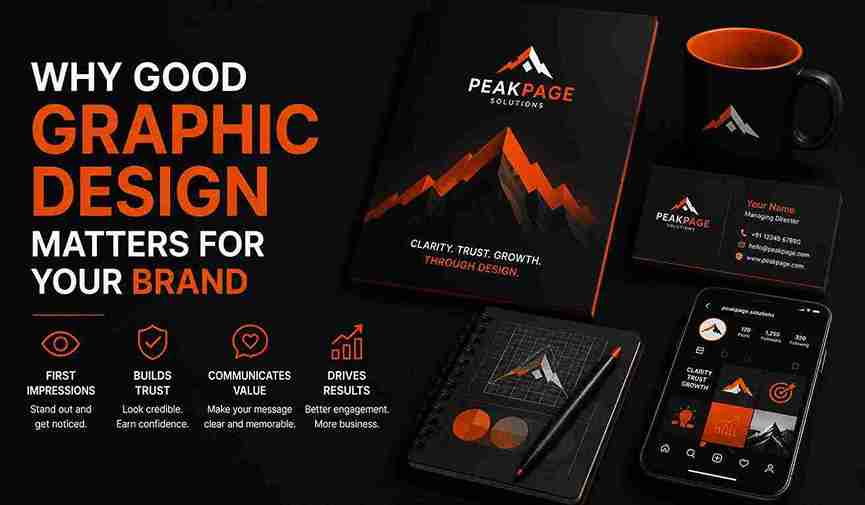
Before someone reads your website copy, compares your services or asks about your pricing, they have already seen something.
Your logo.
Your colours.
Your typography.
Your social post.
Your brochure.
Your website.
And that's why I don't see graphic design as “making things look nice.”
Good design helps a business look understandable, feel credible and become easier to remember.
Think about two businesses offering almost the same service. One presents itself with inconsistent colours, stretched images, five different fonts and random social media graphics. The other has a clear visual system that feels consistent wherever you encounter it.
Neither visual impression tells you whether the business is actually better.
But the first impression can influence whether someone gives either business the opportunity to prove it.
So, what does “good graphic design” actually mean?
Good graphic design is not simply attractive design. It is intentional visual communication using hierarchy, typography, colour, imagery, spacing, composition and consistency to help the right person understand and remember a message.
That distinction matters.
A beautiful poster can still fail if nobody understands what it is promoting.
A minimal logo can still fail if it doesn't work at the sizes and places the business actually needs.
A sophisticated colour palette can still fail if every designer on the team uses it differently.
1. People don't experience your brand in one place
This is where many businesses underestimate the importance of design.
Your brand isn't only your website.
A customer may discover you through one channel, validate you through another and finally contact you somewhere else.
If every touchpoint looks like it belongs to a different company, the customer has to rebuild their understanding of your brand every time.
2. Consistency builds recognition
Imagine seeing a familiar colour combination, type style or visual pattern and immediately knowing which company it belongs to even before you read the name.
Recognition doesn't happen because someone chose a nice shade of orange once.
It happens because the same visual language is repeated intelligently over time.
3. Design can make a complex message easier to understand
This is one of the most practical benefits of good graphic design.
Suppose your business has six services, three customer segments and several advantages.
You could write a long paragraph explaining everything.
Or you could structure the information visually.
Good design gives the eye a route.
This is why graphic design is closely connected to communication not decoration.
4. Your logo is important, but your brand is bigger than your logo
A common mistake is to treat the logo as the entire brand identity.
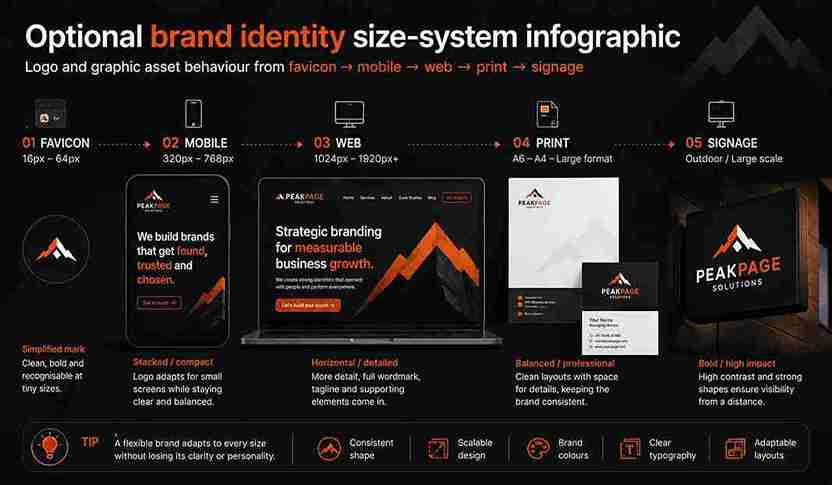
A logo may appear on a tiny mobile screen, a huge signboard, a proposal, a social profile, a T-shirt and a printed document.
It needs a system around it so the brand can remain recognisable even when the logo isn't the main element.
5. Good design creates perceived professionalism
Let's be careful with the word “professional.”
A polished design doesn't automatically make a business professionally operated.
But presentation influences perception.
That confidence still needs to be supported by real evidence: experience, reviews, work, expertise, service quality and transparent communication.
Design opens the door. The business has to earn the trust.
6. Different industries need different visual signals
There is no universal “professional design.”
The right visual language depends on what the business sells, who it serves and what the audience expects.
Copying another industry's visual language simply because it “looks premium” can create the wrong signal.
7. Graphic design can influence buying decisions
Design rarely makes someone buy something by itself.
But it can influence the journey toward a decision.
This becomes especially important in crowded categories where customers can compare several businesses in minutes.
8. Social media makes weak design visible very quickly
Social platforms have turned design into a repeated public touchpoint.
One inconsistent post isn't usually the problem.
The problem is when the feed becomes a visual lottery.
Your social feed doesn't need every post to look identical.
It needs enough consistency that the audience can recognise the source.
9. A good design system makes content production easier
This is a benefit businesses often notice only after they create a proper visual system.
Once you have defined templates, typography, colours, graphic elements and layout rules, your team can create content more consistently and often more efficiently.
10. Design saves attention when it removes unnecessary effort
Your customer has limited attention.
Good design doesn't demand that they decode the page.
This is why spacing matters.
Why alignment matters.
Why contrast matters.
Why typography matters.
None of these elements exist only for aesthetics.
They help the visitor process information with less mental effort.
11. Good design needs to work at different sizes
A graphic that looks beautiful on a desktop presentation can become unreadable on a phone.
A logo that looks perfect on a website can become a blurry mess on a large sign.
This is why professional design should consider real-world usage, not just the artwork on the designer's screen.
12. Design should make your brand easier to remember
Memorability isn't about making everything loud.
Sometimes a distinctive visual system is created through restraint.
That's why a strong brand identity can become an asset over time.
13. Good graphic design is not the same as following trends
Design trends can be useful.
But there is a difference between using a trend as a tool and building your entire brand around whatever is popular this month.
A visual style should survive long enough for people to recognise it.
If you redesign your identity every time social media changes its aesthetic, you may be resetting the memory you're trying to build.
14. Your design should match the quality you claim
This is where design becomes especially emotional for a business owner.
You may have spent years building expertise.
You may have invested in equipment, people, processes and customer service.
You may genuinely be excellent at what you do.
If there is a large gap between those two, the business has a communication problem.
Good design helps reduce that gap.
Not by pretending to be something you're not but by presenting the real quality of the business with the same care.
15. Graphic design works best when it connects with your website
Your website is one of the places where the entire visual identity has to come together.
When these elements work together, the website feels less like a template and more like a complete brand experience.
That is why strategic website development should account for visual identity from the beginning rather than treating graphics as something added at the very end.
16. Graphic design and marketing should not live in separate worlds
Here's a practical example.
Suppose your marketing team is promoting a new service.
If the ad looks premium but the landing page looks completely unrelated, the experience breaks.
If the landing page is strong but the social graphics are confusing, the first impression becomes weaker.
Brand design should support the whole journey.
17. What should a practical brand design system include?
You don't necessarily need a huge brand book.
You need enough guidance that your brand doesn't depend on one designer remembering everything.
18. How to know whether your current design needs work
If you answered “no” to several of these, you may not have a graphic-design problem.
You may have a brand-system problem.
19. What good design should never do
20. The real business value of good graphic design
Let's bring all of this together.
None of these benefits mean design can rescue a bad product or poor service.
But if your business is genuinely good and your presentation is weak, you're making the customer work harder than necessary to discover that quality.
How I would approach a graphic design project for a growing business
The goal isn't to create one beautiful poster.
The goal is to create a visual language that can keep working when your business grows.
Final takeaway
Good graphic design isn't about making a business look expensive.
It is about making the business look like itself clearly, consistently and confidently.
Does your brand visually match the business you've built?
We can look at your visual identity across social media, website and marketing materials and identify where consistency, clarity or positioning can be strengthened.
Talk About Your Brand →Graphic Design & Brand FAQ
Why is graphic design important for a brand?
Good graphic design helps a brand communicate clearly, create recognition, maintain consistency and support a credible first impression. It does not replace product or service quality, but it can make that quality easier for customers to understand and remember.
Is graphic design the same as branding?
No. Graphic design is one important part of branding. A broader brand includes positioning, audience, messaging, personality, customer experience and visual identity. Graphic design helps express those decisions visually.
Does a small business really need professional graphic design?
Small businesses can benefit from a clear visual system because customers encounter them across multiple touchpoints. A consistent logo, colour palette, typography, imagery and reusable templates can make the business easier to recognise and present more consistently.
What should a brand identity include?
A practical identity can include a logo system, colour palette, typography, imagery direction, graphic elements, social templates and guidance for applying the identity across digital and print materials.
Should every social media post look the same?
No. A strong brand system allows content to vary while maintaining recognisable visual cues. Consistency should create a family resemblance, not make every post identical.
How often should a business redesign its brand?
There is no universal schedule. A redesign is usually more useful when the existing identity no longer reflects the business, has become inconsistent, does not work across current channels or creates a meaningful gap between the company's actual quality and its presentation.